
PH lamp
Poul Henningsen's original three-shade lamp of 1925–26, made by Louis Poulsen in Copenhagen.
- Designed by
- Poul Henningsen
- Made by
- Louis Poulsen
- First made
- 1926
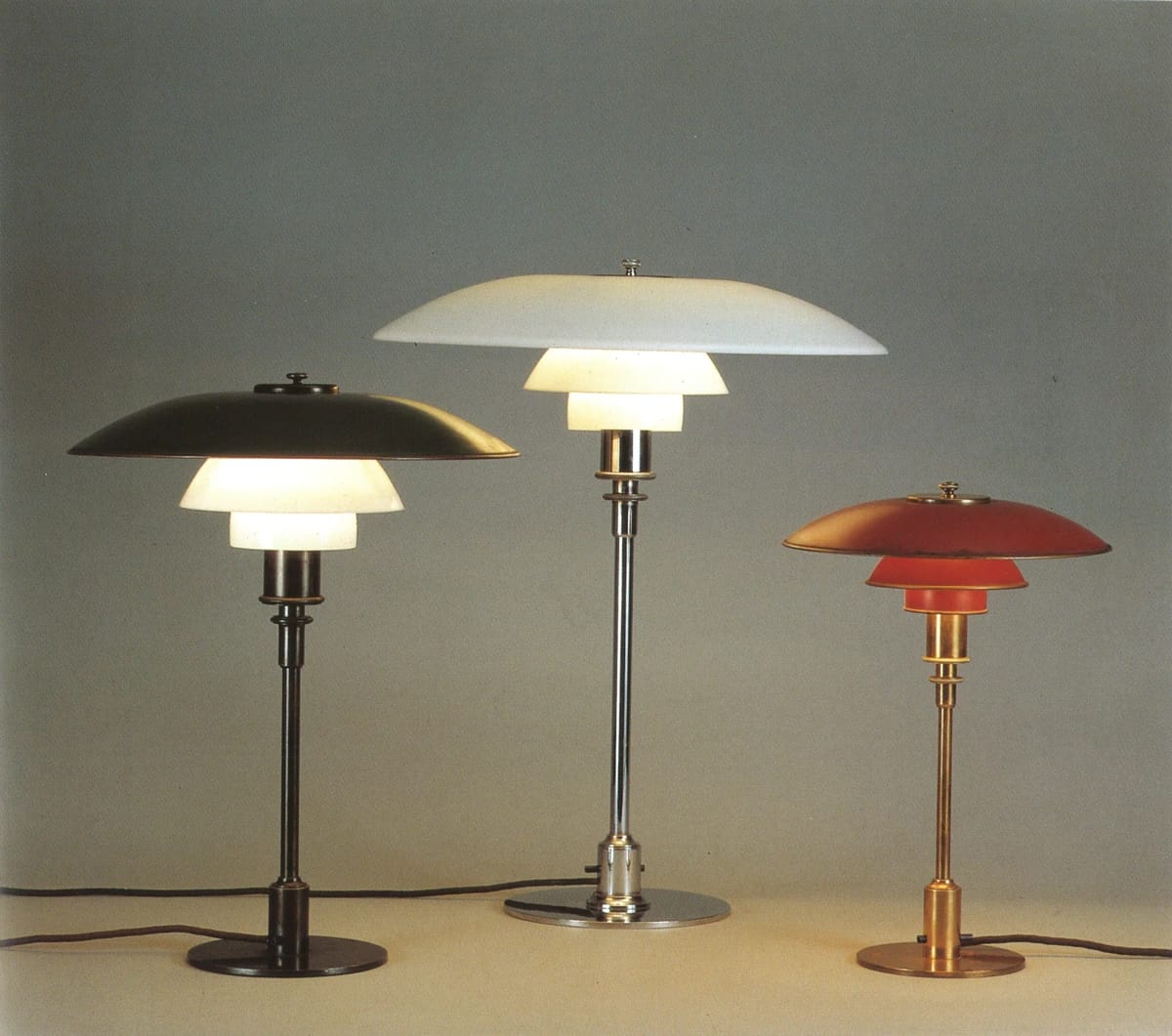
Pictures © Louis Poulsen, from louispoulsen.com.
Why it is renowned
The PH lamp is the first of Poul Henningsen's glare-free lamps, built so that the bulb is hidden and only reflected light leaves the shades.1 The Victoria and Albert Museum in London holds an early table lamp of the three-shade design, made by Louis Poulsen in Copenhagen in 1928 and shown in its galleries.2 The Metropolitan Museum of Art in New York holds a PH table lamp of 1927, bought in 2000.3
The story
Henningsen began working with Louis Poulsen in 1924, and his lamp won a gold medal at the Paris exhibition of 1925.4 After Paris the two were asked to light the new Forum hall in Copenhagen; the lamp Henningsen drew for it had three shades whose sizes set how much light each one reflected.5 In 1926 and 1927 he turned it into a system of three shades in a fixed ratio, made as table lamps, floor lamps and pendants in several sizes, colours and materials.5 The V&A's example has three shades of white opal glass on a cast brass frame with nickel-plated fittings, and a bakelite switch rod running through the stem.2 Its early examples are kept in museum collections, among them the V&A in London and the Metropolitan Museum of Art in New York.23 The PH 5 and the PH Artichoke of 1958 grew out of this work and have their own pages.4
Sources
- PH-lamp, Wikipedia. en.wikipedia.org, read 1 October 2026.
- Table lamp, Victoria and Albert Museum, M.26-1992. api.vam.ac.uk, read 1 October 2026.
- "PH" Table Lamp, The Metropolitan Museum of Art. collectionapi.metmuseum.org, read 1 October 2026.
- Louis Poulsen Heritage, Over 150 Years of Danish Lighting Design. louispoulsen.com, read 17 October 2026.
- Poul Henningsen, Wikipedia. en.wikipedia.org, read 1 October 2026.
Last checked 17 October 2026, against the maker's own pages.