
PH 5
Poul Henningsen's pendant of 1958, a set of shades that hides the bulb, made by Louis Poulsen.
- Designed by
- Poul Henningsen
- Made by
- Louis Poulsen
- First made
- 1958
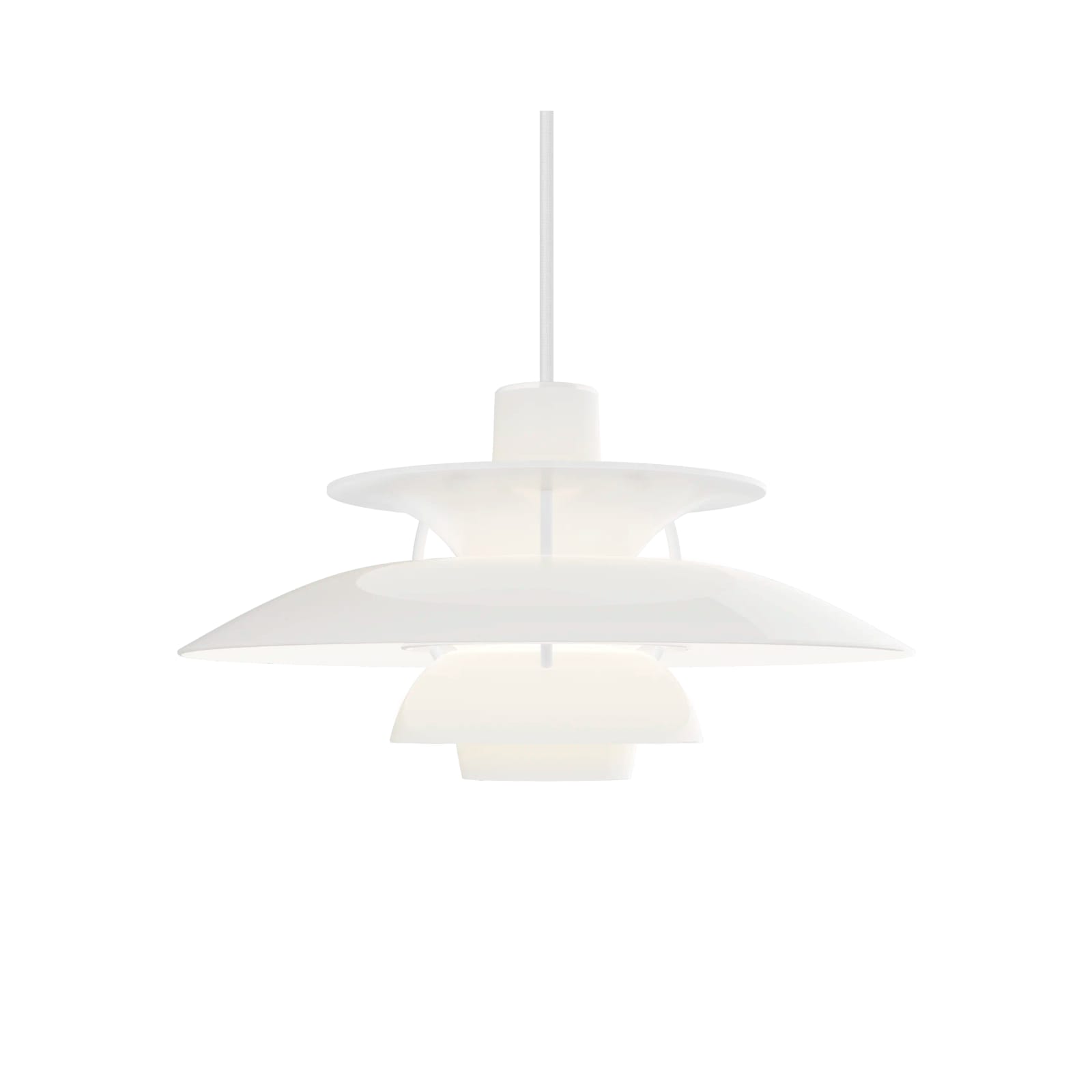
Pictures © Louis Poulsen, from louispoulsen.com.
Why it is renowned
The PH 5 is the most popular of Poul Henningsen's lamps, and Nordiska museet in Stockholm holds a cut-away PH 5 that was used at Konstfack to teach interior architects how its shades spread the light.1 Henningsen's many-shaded lamps began with a gold medal at the Paris exhibition of 1925,2 and his PH table lamp of 1927 is in the collection of the Metropolitan Museum of Art in New York.3
The story
Henningsen spent his career on glare-free light: his lamps reflect and screen the light of the bulb so that none of it reaches the eye directly.2 In 1926 and 1927 he turned his early designs into a three-shade system.2 He made the PH 5 in 1958 to take any bulb as their shapes and sizes kept changing; the PH Artichoke followed the same year.45 Four outer shades send the light down and out, and two small red and blue shades inside warmed the light and helped it render colour; later versions dropped them.14 Louis Poulsen, with which he worked all his life, makes it.2
What to know it by
- PH 51958Poul HenningsenPendant
- PH Artichoke1958Poul HenningsenPendant of the same year
- Paris lamp1925Poul HenningsenGold medal in Paris
Sources
- Taklampa, Nordiska museet. digitaltmuseum.se, read 28 September 2026.
- Poul Henningsen, Wikipedia. en.wikipedia.org, read 28 September 2026.
- "PH" Table Lamp, The Metropolitan Museum of Art. collectionapi.metmuseum.org, read 28 September 2026.
- PH 5 Opal, Louis Poulsen. louispoulsen.com, read 28 September 2026.
- Artichoke Lamp, Art Institute of Chicago. api.artic.edu, read 28 September 2026.
- PH-lamp, Wikipedia. en.wikipedia.org, read 28 September 2026.
Last checked 28 September 2026, against the maker's own pages.